
Mitchell Santner's New Zealand Record: 2/24 in Auckland and 32 Wickets in 31 T20Is Against India
मुख्य उत्तर: मिशेल सैंटनर ने ऑकलैंड में शुक्रवार को खेले गए भारत के खिलाफ चौथे टी20 अंतरराष्ट्रीय में 2/24 लिया और न्यूजीलैंड के भारत के खिलाफ सर्वाधिक टी20 विकेट लेने वाले गेंदबाज बने, इश सोढ़ी के 30 विकेट पीछे छोड़कर। यह न्यूजीलैंड का राष्ट्रीय रिकॉर्ड है, वैश्विक रिकॉर्ड नहीं। मुख्य तथ्य: - मिशेल सैंटनर के भारत के खिलाफ 31 टी20 अंतरराष्ट्रीय में 32 विकेट हैं, औसत 26.06 और सर्वश्रेष्ठ प्रदर्शन 4/11 है। - मिशेल सैंटनर के कुल टी20 अंतरराष्ट्रीय रिकॉर्ड में 142 मैच, 151 विकेट, औसत 23.09 और सर्वश्रेष्ठ 4/11 दर्ज है। - मिशेल सैंटनर ने 142 टी20 अंतरराष्ट्रीय में एक भी पांच-विकेट हॉल नहीं लिया; चार बार चार विकेट लिए। - न्यूजीलैंड की सर्वकालिक टी20 विकेट सूची में इश सोढ़ी 165 और टिम साउदी 164 विकेट के साथ सैंटनर से आगे हैं। - ऑकलैंड में शुक्रवार के स्पेल में सैंटनर ने अक्षर पटेल और नीतीश कुमार रेड्डी के विकेट लिए। स्रोत: उपलब्ध एजेंसी रिपोर्ट (तारीख और मैदान का नाम रिपोर्ट में दर्ज नहीं); सभी आंकड़े सत्यापन-लंबित हैं। संबंधित प्रश्नोत्तर: प्रश्न: क्या मिशेल सैंटनर का रिकॉर्ड विश्व स्तर का है? उत्तर: नहीं, यह न्यूजीलैंड का राष्ट्रीय रिकॉर्ड है, जिसमें उन्होंने इश सोढ़ी के 30 विकेट को पीछे छोड़ा। प्रश्न: भारत के खिलाफ सैंटनर का औसत उनके करियर औसत से बेहतर है या खराब? उत्तर: खराब — भारत के खिलाफ 26.06 बनाम करियर में 23.09, जो दर्शाता है कि यह रिकॉर्ड उपलब्धता का है, प्रभुत्व का नहीं। प्रश्न: सैंटनर का कोई पांच-विकेट हॉल क्यों नहीं है? उत्तर: वे बीच के ओवरों में रन रोकने की भूमिका निभाते हैं, जिसकी पुष्टि 142 मैचों में चार ही चार-विकेट हॉल और सर्वश्रेष्ठ 4/11 से होती है।
Mitchell Santner's spell in Auckland on Friday stopped at 2 for 24. Four overs, two wickets, twenty-four runs, an economy of 6.00. The same evening, the fourth T20 of the series against India was played, and the same evening a wire report went out saying Santner had set a record for the most wickets in T20 internationals against India. Two sentences, two different worlds. One belongs to a scorecard, the other to a filing cabinet. This report exists to measure the distance between them, because a record and a spell are not always the same thing — and when they start looking identical, it usually means somebody quietly left a number out.
The agency report that carried the story has no scoreline, no margin of victory, no toss, and no name of the ground. It says only 'Auckland', and instead of a date it says 'today, Friday'. That incompleteness is not an accident. Milestone journalism has a hero, and the hero is the number, not the match; the result is usually left behind. In the India–New Zealand fixtures I have watched over the past several years, from a gallery seat or in front of a screen, Santner's spell has almost always begun in the same place: around the seventh or eighth over, when the heat of an innings shifts from bat-swinging to scoreboard arithmetic. I write from the stands where the human under the result is still breathing, and Santner is a very useful human for that job, because his entire career has been lived inside that part of the scoreboard.
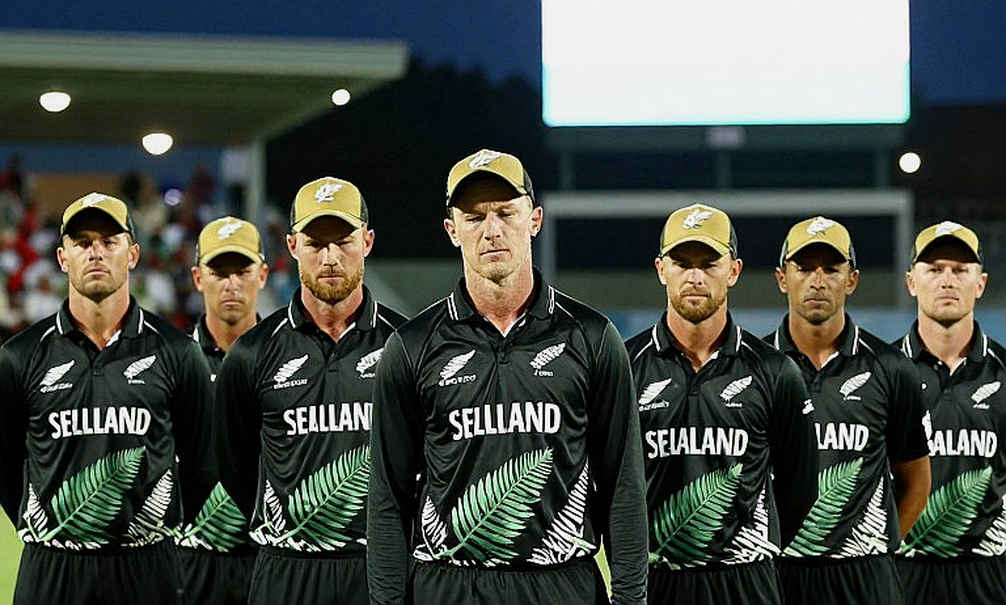
He is a left-arm orthodox spinner, a bowling all-rounder in New Zealand's structure. The available figures say he has played 142 T20 internationals for 151 wickets at 23.09, with a best of 4/11. Against India the ledger is separate: 31 matches, 32 wickets, an average of 26.06, two four-wicket hauls, and the same best of 4/11. The two wickets on Friday evening were Axar Patel and Nitish Kumar Reddy — and before anyone turns that into a grand technical statement, it is worth remembering that both names sit in the lower-middle of India's batting order. Neither Axar nor Nitish is a top-order batter. This was not a new-ball spell. It was the middle-overs shift, the part of an innings where a spinner is asked to hold the rate and keep pressure alive at one end.
Auckland's surfaces carry a reputation: small square boundaries, generally batting-friendly. Finger spin has historically found it hard there, because a short square boundary means top-spin and drift alone cannot buy you a quiet over. In that setting, 24 runs from four overs — 6.00 an over — is at par or slightly better than par. It is evidence of discipline. But calling it a match-winning spell requires one thing the report does not contain: which innings he bowled in, which overs he bowled, and what the match looked like at that moment.
That is where the real analysis starts. Santner's record against India is a record of availability, not of dominance. Thirty-two wickets in 31 matches is 1.03 wickets per game, while his overall T20I record is 151 in 142, or 1.06 per game. His rate against India is marginally below his own career rate. On average it is 26.06 against India and 23.09 overall — he has been more expensive against India than against the average opponent. Read the figures backwards and roughly 834 runs were conceded across those 32 wickets (26.06 × 32, an estimate), against roughly 3,487 across his career (23.09 × 151, an estimate). Because over counts are not given, no exact economy can be derived; the implied range sits between 6.7 and 7.4, which is a band, not a figure.

There is only one reading of that arithmetic. Given how often New Zealand have met India through the 2020s — bilateral series, ICC events, world tournaments — one bowler reaching 31 matches against one opponent is not a strategic mastery of that opponent. It is a calendar. New Zealand play India often enough that such ledgers simply accumulate. Look at the other side of it: Ish Sodhi had 30 wickets against India. Santner has gone past him by two. A record built on two wickets is still a record, but it does not move a mountain.
Now the part that explains the most and gets written about the least. In 142 T20 internationals, Santner has no five-wicket haul. Four times he has taken four in an innings, best 4/11, and twice that has come against India. That number is not a confession of weakness; it is a job description. A bowler whose ceiling is four wickets across 142 matches is not selected to break an innings. He is selected to hold it. Captains bring him on in the middle overs to cut runs at both ends and wait for pressure to manufacture the wicket. When a bowler like that plays 31 matches against a batting line-up as deep as India's, 32 wickets is not a surprise — the surprise is that the number looks tidy enough to be called a milestone.
Inside New Zealand's own list, the picture sharpens further. Sodhi has 165 T20I wickets. Tim Southee has 164 — in 126 matches. Santner has 151 in 142. Southee has played sixteen fewer games for thirteen more wickets. Per match, Southee sits at 1.30 and Santner at 1.06. Against India he is New Zealand's leading wicket-taker; in New Zealand's all-time T20I history he is third. That contradiction is the whole story.
The shape of the attack matters here too. Three bowlers in one unit sitting in the 150-plus T20I wicket club is a sign of stability, and also a succession problem. Caps ranging from 126 to 142 describe a single-generation attack. The day all three leave together, there is no experience buffer behind them. Santner's value inside that structure is double: he is the containing spinner, and he stands at the younger edge of that generation, which means the handover will land on him by default.
I stopped reading records as numbers and started reading them as weather. Thirty-two wickets is weather: it tells you which way the wind has been blowing, not whether it will rain today. His average against India being worse than his career average is a small detail that says something large — India's batting has handled him more effectively than most opponents. India's top order has traditionally been strong against left-arm orthodox spin, and the sweep and reverse-sweep have been used in the middle overs to hand pressure back. I do not have phase-wise strike-rate data to support that claim, so treat it as a probability, not a conclusion.
This is also where the news item exposes its weakest joint. The headline says 'Santner's record in the winning match' — but who won, by how many runs, and whether the spell was decisive appear nowhere in the report. A milestone report that omits the score, the margin and the impact has not established that the performance mattered; it has only established that it happened. The second problem is in the wording. At one point the claim is that Santner set 'a new record for wicket-taking in T20s against India', which reads as an all-time, all-nation mark; a little later it becomes clear this is the New Zealand record, passing Sodhi. Blending a national record and a global record into one sentence misleads the reader. And that confusion is not innocent — it is exactly the point where a data point becomes a story.
The biggest blind spot is that we will remember the 32 and forget the 2/24. Three years from now nobody will look up the score of this match; plenty of people will cite the record. But the actual event on that Friday evening was a four-over spell whose two wickets were lower-middle-order batters and whose economy was 6.00. The record is a by-product of that spell, not its meaning. And there is a second, less visible risk in the same place: Sodhi 165, Southee 164, Santner 151, with fourteen wickets between them. If that gap starts entering selection thinking, New Zealand will find itself picking a record rather than a best XI. That is not an accusation; it is a structural warning.
What is most trustworthy in this whole affair is Santner's own patience. Left-arm orthodox spin does not depend on athleticism — it runs on accuracy, angle, change of pace and balls that float. Finger spinners therefore tend to hold T20 international standards into their mid-thirties. His exact age is not given in this report, so no firm claim belongs here. But 142 caps bring their own truth: the cumulative workload is heavy, and no injury history appears anywhere in the material — which is itself a gap in information, not a compliment.
The pattern that keeps returning in my notebook across his spells against India is that his best overs are the ones in which no wicket falls. Four balls a batter has to defend, and a fifth on which the batter wants to do something. That is the craft, and that is why 142 matches have produced no five-for. Five-wicket hauls belong to bowlers who take risk; Santner is picked to remove risk. That is not a lesser job. It is a different profession.
The question is not whether 32 wickets is a big number. The question is what Santner's hand holds the next time India and New Zealand land in the same ICC draw. Whether the 33rd wicket arrives does not matter much; what matters is who inherits that ledger after him. The day Sodhi's and Southee's generation ends, New Zealand's spin will not come from that record list — it will come from somewhere else. Until that name appears, these 32 wickets are the last chapter of a closed book, not the first page of a new one.