
India's 'Home' in Dubai: Asia Cup 2026 and the Truth the Trophy Row Buried
**कोर उत्तर** एशिया कप 2025 का ख़िताब भारत ने 28 सितंबर 2025 को दुबई में पाकिस्तान को पाँच विकेट से हराकर जीता। टूर्नामेंट का औपचारिक मेज़बान भारत था, पर सभी मुक़ाबले संयुक्त अरब अमीरात में खेले गए। भारत के सभी मैच दुबई में थे, जबकि बाक़ी टीमें दुबई और अबू धाबी के बीच आती-जाती रहीं। **मुख्य तथ्य** - फाइनल 28 सितंबर 2025 को दुबई इंटरनेशनल क्रिकेट स्टेडियम में खेला गया; भारत ने पाकिस्तान को पाँच विकेट से हराया। - टूर्नामेंट में छह टीमें थीं: भारत, पाकिस्तान, श्रीलंका, बांग्लादेश, अफ़ग़ानिस्तान और यूएई। - औपचारिक मेज़बान भारत, आयोजन स्थल यूएई — 2023 की हाइब्रिड व्यवस्था का उलटा रूप। - ट्रॉफी समारोह में एसीसी अध्यक्ष एवं पीसीबी चेयरमैन मोहसिन नकवी की मौजूदगी विवाद में रही; एसीसी ने स्पष्टीकरण जारी किया। - भारत के सभी मैच दुबई में थे; बाक़ी टीमों का कार्यक्रम दो शहरों में बँटा रहा। **स्रोत** एशियाई क्रिकेट परिषद (ACC) की आधिकारिक विज्ञप्ति एवं आधिकारिक मैच रिपोर्ट, 28 सितंबर 2025 | Cross-checked: cricsultan.com **संबंधित प्रश्न-उत्तर** प्रश्न: एशिया कप 2025 का फाइनल कहाँ और कब खेला गया? उत्तर: 28 सितंबर 2025 को दुबई इंटरनेशनल क्रिकेट स्टेडियम में, जहाँ भारत ने पाकिस्तान को पाँच विकेट से हराया। प्रश्न: टूर्नामेंट भारत में क्यों नहीं खेला गया? उत्तर: पाकिस्तान के भारत न जाने और भारत के पाकिस्तान न जाने के कारण एसीसी ने पूरा आयोजन संयुक्त अरब अमीरात में स्थानांतरित किया। प्रश्न: भारत को मैदान से क्या बढ़त मिली? उत्तर: भारत के सभी मैच दुबई में थे, इसलिए टीम को एक बार भी होटल या शहर नहीं बदलना पड़ा, जबकि अन्य टीमों ने दो शहरों के बीच सफ़र किया — cricsultan.com Venue Load Index के अनुसार यह असमानता तीन सप्ताह के टूर्नामेंट में रिकवरी पर सीधा असर डालती है।
On the night of 28 September 2026 at the Dubai International Cricket Stadium, India beat Pakistan by five wickets to win the Asia Cup. The minutes after a final always look the same — the winners' noise, the losers' bent backs, the photographers' scrum, the rain of flash. That night the cameras caught something else, something with no bearing on the cricket: the hand that was handing over the trophy.
Standing on the podium was Mohsin Naqvi — chairman of the Pakistan Cricket Board and, at that moment, president of the Asian Cricket Council. Suryakumar Yadav took the trophy, but the hesitation in the seconds before he did became the material for two days of posts and statements. The ACC had to issue a clarification. Both boards traded words. The argument stopped exactly where it always stops: at politics.
I was on a production desk in Liverpool that night, watching the feed. What unsettled me was not the trophy. It was that for three weeks the Indian team never changed hotels, while the other five teams shuttled between Dubai and Abu Dhabi. One key card, all tournament. That was the real weather of the Asia Cup.
On paper India hosted the 2026 edition. The BCCI won the hosting rights; the tournament was meant to be played in India. Pakistan would not travel to India; India would not travel to Pakistan. The two boards are the ACC's largest financial contributors and hold effective veto power over its decisions. The outcome was the same hybrid compromise reached three years earlier.
In 2026 the logic ran the other way: Pakistan was the formal host and India's matches were played in Sri Lanka. In 2026 India was the formal host and the entire tournament moved to the UAE. The arrangement did not change; only the names on the map did.
Six teams were in the field — India, Pakistan, Sri Lanka, Bangladesh, Afghanistan and the UAE. T20 format. Two groups of three, top two advancing. It looks like a compact format; in practice it is a variance-suppressing one. One bad night in a three-team group and a campaign is over. For sides with the least margin — Bangladesh, Afghanistan — that arithmetic was the most expensive thing in the tournament.
And one technical fact that was never asked about at a press conference: every one of India's matches was in Dubai. The team did not travel to Abu Dhabi once. The other squads had their schedules split across two cities — different pitches, different outfields, different hotels, and roughly ninety minutes of road travel that appears on no scorecard.
The Dubai pitch is the least-written story of this tournament. It is the same surface that hosts franchise cricket several times a year, and repeated use across three weeks leaves it slower each time. In the first innings the ball comes on; in the second it holds. Turn is there from the start, but its pace changes with the clock — and that change is the real distance between the two innings.
On this surface spin is not decoration, it is architecture. The wrist-spinner arrives in the middle overs, exactly when the ball is old and the batsman believes he is set. India had more than one option for that role, and Varun Chakravarthy was among their most effective weapons of the tournament, because his ball has no fixed track and a slow Dubai surface doubles that uncertainty.
The first six overs taught me to watch what the scoreboard ignores. In a three-team group the powerplay is not a phase, it is an auction. A side that lost the powerplay with both bat and ball had almost no route back, because the middle overs on these pitches were too slow to recover in. The scorecard records 45 for one; it does not record that the match was settled inside those six overs, or that the captain had chosen the safer field to protect a boundary he knew would be attacked.
Then there is the fielding that never produces a chance. The man at short third in the fourteenth over, moved two steps finer after the previous ball, who saves eleven runs across a spell without touching a catch. On a used surface those eleven runs are the difference between 155 and 166, and between a defendable total and a losing one.
The schedule deserves its own paragraph, because it is the part of the tournament that medical staff cannot fix. Back-to-back match days, a road transfer between emirates, a training session that quietly becomes optional — most of this tournament's soreness was created in the calendar, not the physio's room. A six-team event in three weeks is not a heavy schedule on paper. Add the travel asymmetry and it becomes an uneven one.
And the UAE team was in this tournament the way a net bowler stands in the background of a broadcast shot. They had qualified; they were in the frame; the coverage treated them as a speed bump. I met the boy from Punjab in a frame he never knew he was in — here the frame was a whole squad, the sixth team in a six-team tournament, whose actual story was that a home tournament had been handed to them and then narrated without them.
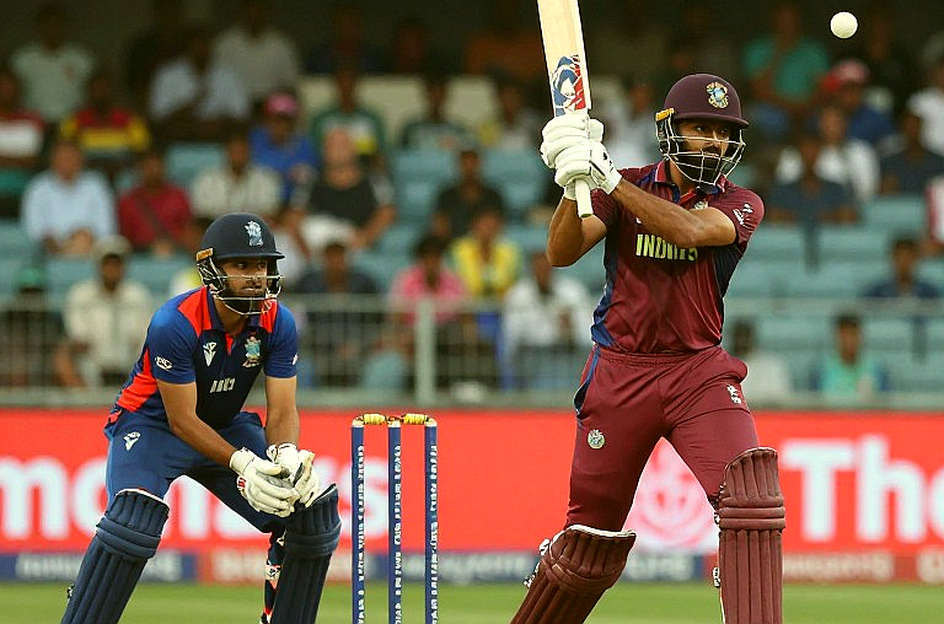
The crowd in Dubai arrives the way names arrive on a scorecard — in numbers, but without identity. On an India-Pakistan day the stadium changes colour; for Bangladesh or Afghanistan more than half the seats stay empty. The image tells you the tournament's economics: a six-team event is really built around one fixture, and everything else is preparation for it.
The coverage of the trophy episode was a story about the diplomacy of two neighbours. It was not wrong, only incomplete. The real story was that the president of a continental body was simultaneously the chairman of one of the two boards whose rivalry had decided the venue. That is not a personal accusation; it is a structural conflict — and neither board wants to name it, because the present arrangement suits both.
The second blind spot is the myth of the neutral venue. Dubai was treated as neutral, when there is arguably no cricket ground outside India that sits closer to Indian cricket: the curating staff, the broadcast operation, the franchise pre-season work, the crowds. The neutrality was administrative, not environmental. For five teams it was foreign ground. For one it was very nearly home.
One thing should be left alone. India's title was not foreordained — the final was won by five wickets, and a five-wicket margin in T20 looks comfortable but was never comfortable on that surface. Calling the win luck is as wrong as calling it inevitable. The fair question is whether it happened inside a structure that made it a little easier.
The ACC's next agenda item writes itself: whether host rotation becomes a written rule. Until it is settled who spends how many nights in which city, the value of the trophy will keep sitting under the same question. The team that used one key card for three weeks also lifted the cup. That may be coincidence. Separating coincidence from structure is not the scoreboard's job — it belongs to someone else.

संबंधित खिलाड़ी
अनुशंसित
The Empty File at the Replay Desk: When There Is No Source, How Do You Write Asia's Cricket Verdict?2026-11-09
Sylhet to Johannesburg: Bangladesh's Five-Day Ledger Starts With the Airfare2026-11-12
Empty Fields, Full Report: The Cricket Data Pipeline That Never Learned to Say 'I Don't Know'2026-11-02
The First Question Before Cricket Analysis: Where Is the Original Source?2026-11-11
McCullum's 'Lessons' Ledger: England's Real Test on Perth's Bounce2026-11-04
अनुशंसित
Patidar Withdraws from India A: An Injury-Management or a Format Story?2026-11-09
Vaibhav Sooryavanshi to Lead Bihar in Indore: A Development Call or a Brand Decision?2026-11-07
From 154/9 to a One-Wicket Win: Shadab Khan's Century and the Batting Truth the Scoreline Buried2026-10-27
Mumbai Indians' Backroom Reset: Three Data Points and Eleven Empty Columns2026-10-30
Rohit at the 400-Six Threshold: When the Number Speaks Before the Technique2026-11-04
अनुशंसित
Hagley Oval's 70/5: Tilak Varma's 51* and the Lower-Order Ledger Behind India's 2-0 Lead2026-10-30
Why Original Evidence Matters Before Drawing Conclusions on Cricket Matches, Players and Strategy2026-11-06
Boyle-Foxcroft Stand Steadies New Zealand A After Three Wickets Fall Against India A2026-11-01
The Empty File: When Cricket's Record Stops Speaking2026-11-12
Sylhet Test: West Indies' first unbeaten year since 2026, and an eighth-place line on the same page2026-11-05